Mesh is a freestanding x86_64 kernel written in C++ and x86 assembly. It boots through Limine, replaces the bootloader-provided page tables, installs its own descriptor and interrupt tables, configures the local and I/O APICs, starts additional processors and enters an interrupt-driven idle loop.
This post follows that initialization path in execution order. It focuses on the boundaries where the firmware, bootloader, CPU state, and kernel code meet. It is not a general introduction to x86 OS dev. I want to document how these components currently fit together in Mesh.
The implementation here is still kernel infrastructure rather than a complete operating system. User processes, syscalls, filesystems, storage drivers, etc. are not yet implemented.
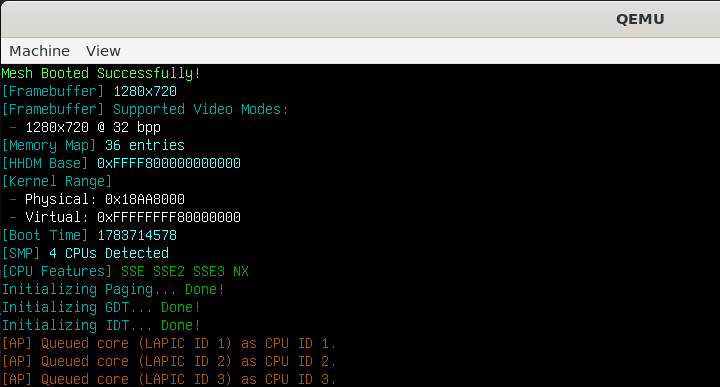
Mesh running under QEMU with four virtual CPUs.
Establishing the boot contract with Limine
Before Mesh can initialize its own memory manager or interrupt controllers or anything, it needs an environment in which it was loaded. The kernel obtains this info through the Limine boot protocol.
Limine takes care of the firmware part of the boot process and starts Mesh in 64-bit mode. It also provides responses containing the physical memory map, framebuffer information, ACPI root pointer, kernel load addresses, etc.
Mesh declares the information it needs as request structs:
#include <core/limine.h>

__attribute__((used, section(".limine_requests")))
volatile struct limine_framebuffer_request framebuffer_request = {
    .id = LIMINE_FRAMEBUFFER_REQUEST,
    .revision = 0
};

__attribute__((used, section(".limine_requests")))
volatile struct limine_memmap_request memmap_request = {
    .id = LIMINE_MEMMAP_REQUEST,
    .revision = 0
};

__attribute__((used, section(".limine_requests")))
volatile struct limine_hhdm_request hhdm_request = {
    .id = LIMINE_HHDM_REQUEST,
    .revision = 0
};

__attribute__((used, section(".limine_requests")))
volatile struct limine_executable_address_request
executable_addr_request = {
    .id = LIMINE_EXECUTABLE_ADDRESS_REQUEST,
    .revision = 0
};

__attribute__((used, section(".limine_requests")))
volatile struct limine_mp_request mp_request = {
    .id = LIMINE_MP_REQUEST,
    .revision = 0
};

__attribute__((used, section(".limine_requests")))
volatile struct limine_date_at_boot_request date_at_boot_request = {
 .id = LIMINE_DATE_AT_BOOT_REQUEST,
 .revision = 0
};

__attribute__((used, section(".limine_requests")))
volatile struct limine_rsdp_request rsdp_request = {
    .id = LIMINE_RSDP_REQUEST,
    .revision = 0
};

__attribute__((used, section(".limine_requests")))
volatile struct limine_executable_file_request executable_file_request = {
 .id = LIMINE_EXECUTABLE_FILE_REQUEST,
 .revision = 0
};

__attribute__((used, section(".limine_requests")))
volatile struct limine_module_request module_request = {
 .id = LIMINE_MODULE_REQUEST,
 .revision = 0
};
Source: src/core/limine.c
Each structure has an identifier according to the protocol and the response pointer. The response pointer is initially 0. At boot, Limine finds the requests in the kernel image, then processes them before entering the kernel.
Information requested
The requests are used by different parts of the kernel:
| Request | Information provided | Used by |
|---|---|---|
framebuffer_request |
Address, dimensions, pitch and pixel format | Framebuffer renderer |
memmap_request |
Usable, reserved, ACPI and bootloader-owned physical regions | Physical frame allocator |
hhdm_request |
Offset of the higher-half direct mapping | Page-table and MMIO access |
executable_addr_request |
Physical and virtual kernel load bases | Kernel section remapping |
mp_request |
CPU count, LAPIC IDs and AP startup records | SMP init |
date_at_boot_request |
Timestamp supplied during boot | Diagnostic output |
rsdp_request |
ACPI root-system-description pointer | MADT and interrupt-controller discovery |
executable_file_request |
Loaded kernel-file metadata | Boot information and diagnostics |
module_request |
Files loaded alongside the kernel | Future module or filesystem support |
Not every response is required immediately. For example, module_request is present even though there is no userland
image loaded or any filesystem implemented.
The higher-half direct map
One of the most important responses is the HHDM offset:
volatile struct limine_hhdm_request hhdm_request = {
    .id = LIMINE_HHDM_REQUEST,
    .revision = 0
};
It provides a virtual region in which physical memory is mapped with a fixed offset. Within that region, a physical address can be converted to a kernel virtual address using:
virtualAddress = physicalAddress + hhdmOffset;This relationship is used when accessing page tables and memory-mapped hardware. For example, when allocating a physical frame for a new page table, the kernel adds the HHDM offset to it and clears or updates the table using a virtual pointer.
The reverse conversion is:
physicalAddress = virtualAddress - hhdmOffset;This is used when a virtual pointer to a page table must be written as a physical frame address into another paging structure.
It maps the physical memory directly while the kernel page tables and VMM define other regions for the heap, dynamically allocated virtual memory, MMIO and kernel stack.
Physical and virtual kernel addresses
Mesh is linked as a higher-half kernel. Its linker script places the kernel at 0xFFFFFFFF80000000.
The address supplied by the executable-address response allows the kernel to calculate the difference between its linked virtual address and the physical location at which it was loaded:
const uint64_t kernelDelta =
    executable_addr_request.response->virtual_base
    - executable_addr_request.response->physical_base;
A linked virtual address can then be converted to its corresponding physical address:
physicalAddress = virtualAddress - kernelDelta;This becomes important when Mesh replaces the bootloader-provided page tables. The kernel must recreate mappings for its
own .text, .rodata, .data and .bss sections before loading the new top-level page table into CR3.
The executable-address request therefore connects two otherwise separate views of the kernel:
Linked virtual address
        │
        │ subtract kernelDelta
        ▼
Loaded physical address
Multiprocessor records
The multiprocessor request provides one record for each processor made available by the bootloader. On x86_64, these records include:
- the processor identifier;
- the local APIC identifier;
- an entry-point field for starting the processor;
- an additional argument passed to that entry point.
Mesh uses this information to identify the bootstrap processor and prepare the remaining application processors.
volatile struct limine_mp_request mp_request = {
    .id = LIMINE_MP_REQUEST,
    .revision = 0
};
The bootstrap processor performs the initial kernel setup. For every other processor, Mesh prepares an AP-specific stack and logical CPU identifier, stores that information in the record’s additional-argument field, and assigns an assembly trampoline to its startup entry point.
The details of that process are covered later in the SMP section.
ACPI discovery
The RSDP request gives Mesh the starting point for parsing ACPI tables:
volatile struct limine_rsdp_request rsdp_request = {
    .id = LIMINE_RSDP_REQUEST,
    .revision = 0
};
From the Root System Description Pointer, the kernel locates either the RSDT or XSDT and searches for the Multiple APIC Description Table. The MADT describes the interrupt-controller topology, including I/O APICs and interrupt-source overrides.
This information is required before the kernel can correctly route the PS/2 keyboard interrupt through the I/O APIC.
Providing the RSDP through the boot protocol avoids embedding firmware-specific ACPI discovery logic in the early entry path. Parsing and validating the ACPI tables remains the kernel’s responsibility.
The kernel still validates the responses
Declaring a request does not guarantee that a valid response will be returned. A request may be unsupported, malformed or unavailable on a particular system.
Kernel code must therefore check the response pointer before using it:
if (memmap_request.response)
    Renderer::printf("[Memory Map] %u entries\n", memmap_request.response->entry_count);
For essential resources such as the physical memory map or HHDM, initialization shouldn’t proceed without a valid response.
Boot configuration
The Limine configuration identifies the kernel executable and requests a framebuffer mode:
timeout: 0
default_entry: Mesh

/Mesh
protocol: limine
path: boot():/mesh.elf
resolution: 1280x720x32
Source: lib/limine.conf
Limine loads mesh.elf, processes the request structures and enters the executable at its declared entry point. The
requested resolution is used when a compatible mode is available, but kernel code must still use the dimensions and
pitch which is in the framebuffer response.
┌───────────────────┐
│ BIOS or UEFI      │
└─────────┬─────────┘
          │ boot
          ▼
┌───────────────────┐
│ Limine bootloader │
│                   │
│ * loads mesh.elf  │
│ * finds requests  │
│ * fills responses │
│ * provides CPUs   │
│ * provides HHDM   │
└─────────┬─────────┘
          │ _start
          ▼
┌───────────────────┐
│ Kernel            │
│                   │
│ * validate data   │
│ * init renderer   │
│ * rebuild paging  │
│ * configure APICs │
│ * start  APs      │
└───────────────────┘
Limine hence acts as a boundary between firmware startup and kernel init. Mesh doesn’t need to implement the transition from real mode (32-bit) to long mode (64-bit). Its work begins after that using the information supplied through the boot protocol.
Entering the kernel
After Limine has loaded mesh.elf, processed the boot-protocol requests and established a 64-bit environment, control
is transferred to the kernel’s ELF entry point.
The linker script declares _start as that entry point:
ENTRY(_start)Source: lib/linker.ld
As Limine has already performed the earlier boot transition and loaded the kernel according to its ELF layout, _start
does not have to do anything extra.
bits 64

section .text
    global _start
    extern kernelMain

_start:
    lea rsp, [rel stack_top]
    call kernelMain

.hang:
    hlt
    jmp .hang

section .bss
    align 16

stack_bottom:
    resb 16384

stack_top:
Source: src/asm/boot.asm
The purpose of _start is only:
- establish a known bootstrap stack
- transfer control into the C++ kernel
- prevent execution from continuing unpredictably if the C++ entry point returns
Establishing the bootstrap stack
The first instruction initializes the stack pointer:
lea rsp, [rel stack_top]stack_top marks the address immediately after a 16 KiB region reserved in .bss:
stack_bottom:
    resb 16384

stack_top:
Because the stack grows toward lower addresses, execution begins with rsp pointing to the upper end of the reserved
region.
Higher address

        stack_top
            │
            ▼
┌─────────────────────────────┐
│                             │
│     16 KiB bootstrap        │
│          stack              │
│                             │
└─────────────────────────────┘
            ▲
            │
       stack_bottom

Lower address
The bootstrap stack is used only during the early kernel path. Later there are separate stacks for additional processors, per-CPU interrupt handling and kernel tasks.
Using a kernel-owned stack before entering C++ avoids relying on the bootloader’s stack, which may be unsuitable.
Why lea uses a relative address
The instruction uses RIP-relative addressing:
lea rsp, [rel stack_top]In 64-bit mode, rel instructs NASM to encode the address relative to the current instruction pointer rather than an
absolute immediate address.
This is useful because _start and stack_top are both part of the loaded kernel image. Their relative displacement is
fixed by the linker even though the kernel’s final address is selected during boot.
The instruction calculates the virtual address of stack_top during runtime and stores it in rsp.
Transferring control to C++
I chose C++ instead of staying in C for most of the later implementation because it gets easier to reuse code with OOP and templates as I’m not limited to small constraints. The entry point is still a simple assembly stub.
Once the stack is established, the entry point calls the kernel’s C-linkage function:
call kernelMainThe corresponding declaration is:
extern "C" [[noreturn]] void kernelMain()The extern "C" linkage is required because the function is referenced directly by assembly. Without it, the C++
compiler would emit a mangled symbol name which would mess up the naming. It expects the exact symbol kernelMain
rather than _Z10kernelMainv or similar.
What call places on the stack
The call instruction performs two operations:
- it pushes the address of the instruction after
call; - it transfers control to
kernelMain.
Conceptually:
Before call:

rsp -> top of bootstrap stack

After call:

rsp -> return address
       previous stack contents
Stack alignment
The System V AMD64 ABI defines stack-alignment requirements for function calls. The stack should
be aligned so that the function begins with the expected relationship between
rsp and a 16-byte boundary.
The static stack region is aligned:
section .bss
    align 16
and its size is also a multiple of 16 bytes:
resb 16384Therefore, stack_top is aligned to 16 bytes. The call instruction then pushes an 8-byte address before entering
kernelMain().
The resulting entry condition is:
stack_top % 16 = 0

after call:
rsp % 16 = 8
The fallback loop
If kernelMain() returns (despite being declared [[noreturn]], if a fatal error occurs), execution continues at:
.hang:
    hlt
    jmp .hang
hlt stops instruction execution until an interrupt, NMI, SMI or reset occurs.
Why the entry point contains no C runtime setup
Mesh is compiled as a freestanding program. There is no hosted C or C++ runtime available before kernelMain().
The entry point does not invoke a standard main() function, libc startup code, argc/argv parsing, or anything else.
The kernel is built with options such as:
-ffreestanding
-fno-exceptions
-fno-rtti
-nostdlib
-static
As a result, the kernel must provide or avoid facilities that normal application programs receive from the operating system and language runtime.
In the present boot model, the code relies on the environment supplied by Limine for the earliest transition into
kernelMain(). Processor features, paging, descriptor tables, interrupt handling, and other services are initialized
later.
Global constructors
Mesh currently uses global objects, including spinlocks, atomic counters and scheduler arrays. Many of these objects either use static zero-initialization or have simple constructors.
However, the entry path does not contain an explicit mechanism for walking .init_array and invoking global C++
constructors.
It is not required just because the kernel is written in C++, but it’s needed once the code starts to depend on non-trivial static object construction.
using Constructor = void (*)();

extern Constructor __init_array_start[];
extern Constructor __init_array_end[];

void runGlobalConstructors()
{
    for (Constructor* constructor = __init_array_start; constructor != __init_array_end; ++constructor)
        (*constructor)();
}
The linker script would also need to retain the constructor array:
.init_array : ALIGN(8) {
    __init_array_start = .;
    KEEP(*(.init_array .init_array.*))
    __init_array_end = .;
}
Initialization order
Once _start has established the bootstrap stack, control enters kernelMain().
extern "C" [[noreturn]] void kernelMain()
{
    initRenderer();
    initSIMD();
    Renderer::setSerialPrint(true);
    dumpStats();

    initPaging();
    initGDT();
    initIDT();
    SMP::init();
    LAPIC::init(SMP::getLapicBase());

    if (!CPUManager::initCPU(0, mp_request.response->bsp_lapic_id))
        Panic::panic("Failed to initialize primary CPU.");
    if (!CPUManager::initRuntime(0))
        Panic::panic("Failed to initialize primary CPU runtime.");

    initIOAPIC();
    Keyboard::init();
    initLapicTimer();

    Interrupt::enableInterrupts();
    while (true)
    {
        Keyboard::service();
        while (char c = Keyboard::readChar())
            Renderer::printf("%c", c);

        static uint64_t last = 0;
        if (const uint64_t now = LAPIC::timerGetTicks(); now / 1000 != last / 1000)
        {
            Renderer::printf("\x1b[90m.\x1b[0m");
            last = now;
        }

        asm volatile("hlt");
    }
}
Source: src/core/kernel.cpp
The order is not arbitrary. Reordering these calls without understanding those dependencies can cause faults before the kernel has enough data to report what failed.
The current sequence can be divided into six phases:
- Boot diagnostics
- Processor-state preparation
- Memory ownership
- Interrupt and CPU structures
- Device interrupt routing
- Interrupt runtime
Phase 1: Boot diagnostics
The first subsystem initialized is the framebuffer renderer:
initRenderer();The renderer consumes the framebuffer response previously supplied by Limine. It initializes font and framebuffer state, clears the display and provides formatted text output for the rest of the boot process.
Initializing output first is a debugging decision as most following stages interact with privileged processor state or memory-mapped hardware. A failure during paging, GDT, IDT, or APIC init may not show any indication of where execution stopped.
The first boot message (Mesh Booted Successfully!) doesn’t mean that the entire kernel has initialized successfully.
At this point, it has only reached its C++ entry point and initialized the framebuffer output path.
Serial output
After SIMD setup, framebuffer output is mirrored to the serial console for debugging:
Renderer::setSerialPrint(true);Serial output is useful because it remains observable through QEMU’s terminal even when the framebuffer is no longer updating correctly.
The QEMU run target connects the serial device to the host terminal:
-serial mon:stdioPhase 2: Prepare the processor for compiled kernel code
The next call is:
initSIMD();Despite its name, the function does more than prepare optional vector arithmetic. It configures processor state expected by modern x86_64 code.
void initSIMD()
{
    SMP::detectCPUFeatures();
    if (!SMP::getCPUFeatures().hasSSE)
    {
        Renderer::printf("\x1b[31mCPU does not support SSE.\x1b[0m\n");
        return;
    }

     uint64_t cr0, cr4;

    asm volatile ("mov %%cr0, %0" : "=r"(cr0));
    cr0 &= ~(1ULL << 2);
    cr0 |= (1ULL << 1) | (1ULL << 5);
    asm volatile ("mov %0, %%cr0" :: "r"(cr0));

    asm volatile ("mov %%cr4, %0" : "=r"(cr4));
    cr4 |= (1ULL << 9) | (1ULL << 10);
    asm volatile ("mov %0, %%cr4" :: "r"(cr4));

    asm volatile ("fninit");
}
Source: src/core/kernel.cpp
The control-register changes perform the following operations:
| Register bit | Effect |
|---|---|
CR0.EM = 0 |
Disables software emulation of floating-point instructions |
CR0.MP = 1 |
Enables correct interaction between WAIT/FWAIT and task-switching state |
CR0.NE = 1 |
Enables native x87 floating-point exception reporting |
CR4.OSFXSR = 1 |
Allows the operating system to use FXSAVE, FXRSTOR and SSE state |
CR4.OSXMMEXCPT = 1 |
Enables SIMD floating-point exception delivery |
Finally, fninit initializes the x87 FPU to a known state.
The compiler flags include -mgeneral-regs-only. This tells the compiler not to use floating-point or vector registers
for normal generated code. That reduces the amount of SIMD state that must be configured during boot.
Even with that compiler option, explicitly preparing the processor state is still useful because the kernel may later use SSE in handwritten code, memory-management routines, task context management, etc. and it should not completely depend on the bootloader having done that work.
Printing the boot environment
After the renderer and serial channel are available, Mesh prints information supplied by Limine and discovered through
CPUID:
dumpStats();The diagnostic dump occurs before Mesh replaces the active page tables. This is useful because it records the addresses and memory information that will be used during the transition. This also confirms that the bootloader responses are accessible before the memory manager begins relying on them.
Phase 3: Take ownership of memory management
The first major subsystem initialized after diagnostics is paging:
initPaging();The helper function exposes the dependency chain within the memory subsystem:
void initPaging()
{
    Renderer::printf("\x1b[36mInitializing Paging... ");
    if (!FrameAllocator::init()) Panic::panic("Failed to initialize FrameAllocator.");
    if (!Paging::init()) Panic::panic("Failed to initialize Paging.");
    if (!VMM::init()) Panic::panic("Failed to initialize VMM.");
    if (!BuddyAllocator::init()) Panic::panic("Failed to initialize BuddyAllocator.");
    if (!SlabAllocator::init()) Panic::panic("Failed to initialize SlabAllocator.");
    Renderer::printf("\x1b[32mDone!\n");
}
The order within initPaging() is itself constrained:
Limine memory map
        │
        ▼
Physical frame allocator
        │
        ▼
Kernel page tables
        │
        ▼
Virtual memory manager (VMM)
        │
        ▼
Buddy allocator
        │
        ▼
Slab allocator
Physical frame allocator first
The frame allocator identifies and tracks usable physical 4 KiB frames. Page-table creation depends on it because every new page-table level requires a physical frame.
Without a frame allocator, Paging::init() would have no general mechanism for obtaining memory for the PML4, PDPT,
page-directory or page-table structures.
Paging before the VMM
The paging layer creates mappings between virtual and physical addresses and activates the kernel-owned PML4.
The VMM operates at a higher level. It manages virtual address regions such as kernel heap, dynamic memory, MMIO regions, kernel stacks, etc. It therefore requires an operational page-mapping layer underneath it.
Buddy allocator
The buddy allocator manages larger blocks in page units. The slab allocator then subdivides memory into smaller fixed-size objects.
This leads to the allocation hierarchy:
Physical frames
      │
      ▼
Buddy blocks
      │
      ▼
Slab pages
      │
      ▼
Small kernel objects
Task structures and VMM metadata later depend on slab allocation. Therefore, task and per-CPU runtime initialization must occur after this entire memory chain is ready.
Phase 4: Install processor control structures
Once the memory subsystem is available, Mesh installs the Global Descriptor Table.
initGDT();followed by the Interrupt Descriptor Table:
initIDT();The GDT defines the code and data selectors referenced by IDT entries and task-state segments. The IDT then maps exception and interrupt vectors to their handlers.
The bootstrap processor’s GDT initialization also prepares its TSS:
GDTManager::setTSS(0, reinterpret_cast<uint64_t>(&kernelStacks[0][SMP::SMP_STACK_SIZE]));
GDTManager::loadTR(0);
The IDT registers the external interrupt vectors:
IDTManager::setEntry(0x21, isrKeyboard, 0x8E, 0);
IDTManager::setEntry(0x22, isrTimer, 0x8E, 0);
IDTManager::setEntry(0x80, isrYield, 0x8E, 0);
Installing an IDT does not itself begin interrupt delivery. If interrupts were enabled before valid handlers and controller routes existed, a timer or keyboard event could enter an undefined vector.
SMP discovery precedes LAPIC initialization
After the descriptor tables are available, Mesh initializes its multiprocessor topology:
SMP::init();This stage determines the local APIC base and prepares application-processor startup information.
Only after that does the bootstrap processor initialize its local APIC:
LAPIC::init(SMP::getLapicBase());The local APIC is required for timer interrupts, interprocessor interrupts, and End-of-Interrupt signalling.
The additional processors may already have been directed toward their entry paths during SMP::init(). The bootstrap
processor still requires its own CPU structure and runtime state before timer-driven scheduling begins.
Initializing the bootstrap processor’s per-CPU state
The bootstrap processor is assigned logical CPU ID 0:
CPUManager::initCPU(0, mp_request.response->bsp_lapic_id);This initializes the per-CPU structure and associates it with the bootstrap processor’s LAPIC ID.
The next call initializes runtime state:
CPUManager::initRuntime(0);The runtime function assigns the per-CPU scheduler, creates an idle task and marks the processor online.
This must occur after:
- the slab allocator, because task metadata is dynamically allocated
- the VMM, because task stacks require virtual memory
- the GDT, because the CPU needs a valid TSS
- SMP discovery, because LAPIC and logical CPU identity are now known
It must occur before:
- the LAPIC timer begins producing scheduler ticks
- interrupts are enabled
- the scheduler interrupt handler attempts to retrieve the current CPU
Phase 5: Route external interrupts
With paging, the IDT and the bootstrap processor’s local APIC available, Mesh initializes the I/O APIC:
initIOAPIC();The function performs several dependent operations.
In order to detect the existence of an I/O APIC (or multiple ones), the Intel Multi-Processor or ACPI tables (
specifically, the MADT) must be parsed. In the MP tables, configuration tables with the entry identification of 0x01
are for I/O APICs. Parsing will tell how many I/O APICs exist, what are their APIC IDs, base MMIO address and first IRQ.
The MADT also contains entries for interrupt-source overrides, which are used to remap legacy ISA interrupts to global
system interrupts.
The keyboard interrupt is routed through the I/O APIC rather than the legacy PIC. For this, the kernel must map the MMIO region, resolve the ISA interrupt, create a redirection entry in the I/O APIC, and mask the legacy PIC.
The MMIO mapping requires the paging subsystem:
const uint64_t ioapicVirt = madt.ioapicPhys[i] + hhdm_request.response->offset;
if (!Paging::map(
        ioapicVirt,
        madt.ioapicPhys[i],
        FrameAllocator::SMALL_SIZE,
        PageFlags::PRESENT |
        PageFlags::RW |
        PageFlags::CACHE_DISABLE |
        PageFlags::WRITE_THROUGH |
        PageFlags::GLOBAL |
        PageFlags::NO_EXECUTE))
{
    Renderer::printf("\x1b[31mFailed to map IOAPIC %d MMIO.\x1b[0m\n", i);
    return;
}
The keyboard route requires both the IDT and bootstrap processor LAPIC ID:
ACPI::resolveIsa(
    madt,
    1,
    globalIrq,
    activeLow,
    levelTriggered
);
IOAPIC::redirect(
    globalIrq,
    0x21,
    lapicId,
    activeLow,
    levelTriggered
);
Finally, the legacy programmable interrupt controllers are masked:
outb(0x21, 0xFF);
outb(0xA1, 0xFF);
This prevents duplicate or conflicting delivery through the older PIC path.
Initializing the keyboard before enabling interrupts
After its I/O APIC route is installed, the keyboard driver is initialized:
Keyboard::init();Now, the IDT contains the keyboard vector and the I/O APIC contains the route, but maskable interrupts are still globally disabled through the processor’s interrupt flag. This allows device initialization to complete without racing the first IRQ.
Initializing the LAPIC timer
The final interrupt source configured before sti is the local APIC timer:
initLapicTimer();The timer setup is:
void initLapicTimer()
{
    Renderer::printf("\x1b[36mInitializing LAPIC Timer... ");

    LAPIC::timerInit(0x22);
    LAPIC::timerSetDivide(16);
    LAPIC::timerCalibrate(10);
    LAPIC::timerPeriodic();

    CPUManager::getCurrentCPU()->timerReady = true;
    Renderer::printf("\x1b[32mDone!\x1b[0m\n");
}
The timer is assigned IDT vector 0x22, calibrated and placed in periodic mode.
Phase 6: Enable interrupt delivery
Only after all handlers, controller routes and runtime state are available, the kernel enables interrupt delivery:
Interrupt::enableInterrupts();This sets the processor’s interrupt flag, using sti.
From this point onward, the bootstrap processor can receive:
- PS/2 keyboard interrupts through the I/O APIC
- LAPIC timer interrupts
- CPU exceptions
- software-yield interrupts
- interprocessor interrupts
Entering the steady-state loop
After interrupt delivery is enabled, kernelMain() enters its final loop:
while (true)
{
    Keyboard::service();
    while (char c = Keyboard::readChar()) Renderer::printf("%c", c);

    static uint64_t last = 0;
    if (const uint64_t now = LAPIC::timerGetTicks(); now / 1000 != last / 1000)
    {
        Renderer::printf("\x1b[90m.\x1b[0m");
        last = now;
    }

    asm volatile ("hlt");
}
The loop services keyboard characters and prints a dot every second to test the timer.
The hlt instruction avoids continuous waiting. Because interrupts have already been enabled, the processor resumes
when an interrupt occurs.
Current state and next steps
At the end of the boot sequence, Mesh is running with kernel-owned page tables, descriptor tables, interrupt routing, per-CPU state and a periodic LAPIC timer. The bootstrap processor can receive keyboard and timer interrupts, and additional processors are brought online with their own stacks and runtime structures.
The implementation is still kernel infrastructure rather than a complete OS as it doesn’t have any user processes, independent address spaces, syscalls, executable loading, filesystems, device drivers, or anything similar. Scheduling is currently focused on kernel threads, and full task switching is not yet implemented.